Bottom Line Up Front
If your goal is to find verifiable T-shirt sizing and product entry points from the chanel catalog on fashion-reps, you can't just treat the text on the brand catalog or product cards as complete sizing evidence. A more reliable approach is to first record the catalog page, then open the corresponding product detail page, and check item by item: style, color, size options, and detail page URL. If any one of these doesn't match, put it in "pending verification" first; don't directly treat it as a purchasable candidate.
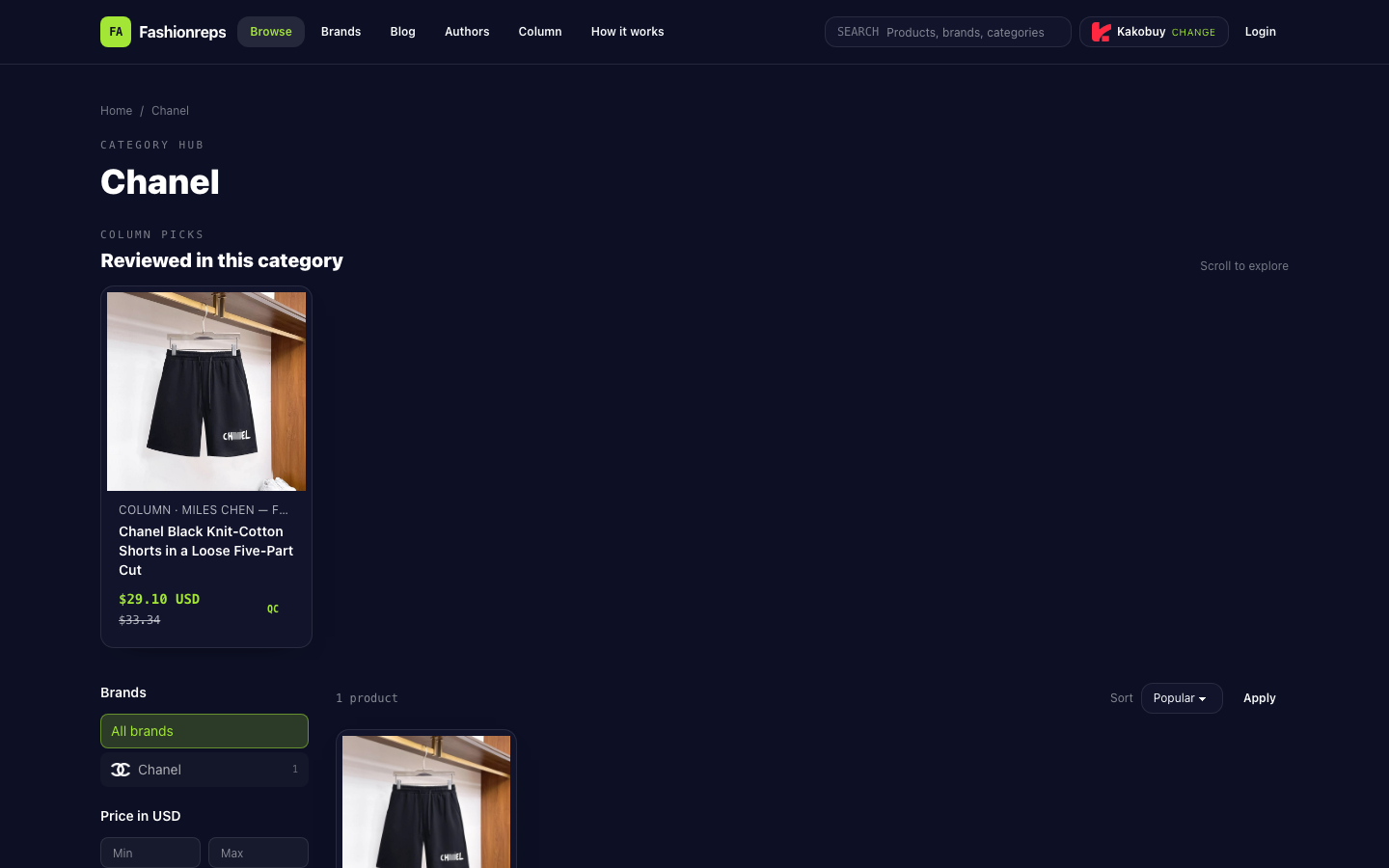
The verified Chanel brand catalog page shows brand categories and product cards, but the provided page evidence features a black knitted cotton shorts with a reference price of $29.10, and the page also shows a previous reference price of $33.34. This evidence cannot prove the existence of a verifiable Chanel T-shirt in the catalog, nor can it prove any sizing, inventory, shipping, or fit. Therefore, the focus of the method below is to establish a verification process, not to treat this card as a T-shirt recommendation.

Illustration: A diagram showing the information layout for verifying T-shirt sizing fields, not an actual product, QC, or personal experience evidence.
What Brand Catalog, Product Cards, and Detail Pages Can Prove
Catalog pages are good for discovering brands and entering products. They can help you confirm the currently viewed brand category, the product cards visible on the page at that time, and whether there are product entry points to continue opening. But the existence of a catalog page doesn't mean that a particular T-shirt already has a complete size chart.
Product cards are typically the second layer of evidence. They may retain product name, color hints, reference prices, or other summary fields. Cards are useful for establishing candidate records, but without size options, measurements, or style correspondence from the detail page, you cannot expand the summary text into complete sizing information.
Detail pages are the key place to verify specific product fields. After opening, you should confirm that the detail page still corresponds to the same style, and check which sizing fields the page actually displays. If there are only size names without chest circumference, length, or other measurements, you should accurately record it as "size options present, but specific measurements not seen", rather than inferring size range or fit.
| Page Level | What Can Be Recorded | What Cannot Be Inferred From It |
|---|---|---|
| Brand catalog | Brand category, page time, visible product cards | T-shirt definitely exists, stock sufficient, sizing complete |
| Product card | Product name, color or summary price and other visible fields on the page | Detail page will definitely have the same fields, fit, actual purchasability |
| Product detail page | Style correspondence, actually displayed sizing fields, detail page URL | Unshown measurements, stock changes, shipping or quality performance |
Verification Steps for chanel T-shirts
1. Save the brand page state first
Record the page name, access date, and the brands or categories actually visible on the page. Don't rewrite the search goal as "found T-shirt". If the page only shows the Chanel category, the candidate status should be written as "brand page verified, T-shirt pending discovery".
2. Copy the product name from the card
Save the name from the product card as-is, and also record the color and other fields displayed on the page. Don't add material, fit, or season information to the name yourself. If the card name doesn't match the target T-shirt, for example, the evidence in this case shows a black knitted cotton shorts, you should stop classifying it as a T-shirt candidate.
3. Open the detail page and verify the same-style relationship
After entering the detail page from the product card, first compare the product name and main image identifying information, then check if the color is still consistent. Only when you can confirm it's the same product can the sizing fields from the detail page be appended to the card record.
4. Record size options and measurements separately
"Shows S, M, L" etc. are size options; "specific values such as chest circumference, length, shoulder width" are measurement evidence. The two cannot be confused. When the detail page only shows size options, record "size names confirmed, specific measurements not confirmed"; when the page has no sizing fields, record "sizing pending verification".
5. Save the detail page entry and verification time
For each candidate, at least save the brand page, product name, color, size options, specific measurements, detail page entry, and last verification time. If the product entry becomes invalid, the page can't be opened, or the fields conflict, don't treat the old record as a current purchasable recommendation.
How the Catalog and Google Sheets Divide Responsibilities
Website catalogs are better for discovering content and navigating from product cards into detail pages. You can observe brand categories, product summaries, and entry points to continue opening in the catalog, then go back to the detail page to complete field verification. Its advantage is that information is connected to the page context, but page content may change over time, and relying solely on browsing records makes it hard to maintain a consistent format.
Google Sheets is better for saving verification results. It can put the status of multiple candidates, missing fields, and verification times in the same table, and also makes it easier to filter by statuses like "pending verification", "sizing confirmed", "detail page invalid". Its role here is to organize observed evidence, not to replace the product detail page, nor to automatically fill in values for missing fields.
Recommended fields:
- Brand page name
- Original product card name
- Color
- Confirmed as T-shirt or not
- Detail page openable or not
- Displayed size options
- Specific measurements present or not
- Page verification time
- Current status
- Pending verification notes
If multiple people collaborate, editors should only modify fields they have confirmed, and write the gaps clearly in the pending verification notes. For example, "detail page openable, but chest circumference and length not seen" is easier to review than simply writing "sizing incomplete".
Situations Where You Should Pause Adding to Candidates
In the following situations, do not continue to add speculative content:
- The catalog card shows shorts, shoes, or other non-T-shirt items.
- The card name is clearly inconsistent with the detail page name.
- The detail page has no size options, or the page cannot confirm the current style.
- Only size letters are present without specific measurements, yet someone asks for a fit judgment.
- The page only shows reference prices and cannot confirm current inventory, shipping, or purchase status.
- The product link is invalid, redirects abnormally, or the page content has changed.
The verified materials in this case are insufficient to give a sizing recommendation for any Chanel T-shirt, nor to confirm purchasability. The safest way to organize the results is to keep the Chanel brand catalog as a discovery entry, and mark the target T-shirt as pending further verification, rather than using the seen shorts card as a substitute for the target product.
Minimal Documentation Workflow on Mobile
When operating on a mobile phone, you can complete it in this order:
- Open the brand catalog and take a screenshot that includes the page name and product card.
- Click on the target product, copy the detail page entry, and take another screenshot that shows the product name.
- Record size options and specific measurements separately; leave fields blank if not displayed.
- Fill in verification time and current status in the spreadsheet.
- Before closing the page, check if the card name, color, and detail page still point to the same style.
- If fields conflict or the entry is invalid, change the status to "pause adding", and wait for new detail page evidence.
Results organized this way can distinguish "catalog discovery", "product card summary", and "detail page sizing evidence". Before there is a corresponding T-shirt detail page, keeping fields empty is more reliable than filling in unverified measurements.