Anti Social Social Club Multicolor T-Shirt Collection Review: Three Packing Set-Ups, One $6.87 Tee and the Autumn Cut-Off
We ordered a $6.87 size M inside the autumn surge and packed it three ways: mailer alone, mailer with a card folder, and a consolidated box. The tee held up; the packing choice moved the billable weight.
Published 30 October 2026 Ellis Tanaka Reviews EditorHands-on parcel preparation, protective packaging, garment fit checks, and QC photo comparisonEllis Tanaka ran the returns bench at a Portland outdoor-gear retailer for four years, which is where he learned that a photographed seam tells you more than a specification sheet. He joined the Almanac in 2020 and now runs the packing bench: weighing, rehearsing, and re-packing parcels for every hands-on review. He keeps a shelf of failed packaging — crushed corner protectors, split mailers, a box that arrived with a footprint on it — and refers to it during scoring meetings.- Who this is for
- Buyers who want a cheap, loose streetwear tee for spring-to-autumn wear, will check the chart per colourway, and will consolidate it with other items so the billable weight earns its keep.
- Who should skip
- Anyone who tumble-dries tees, expects one size label to fit the same across drops, or wants a single-item parcel where the round-up to the next bracket swallows the saving.
Editor score 4.0 / 5
How we tested
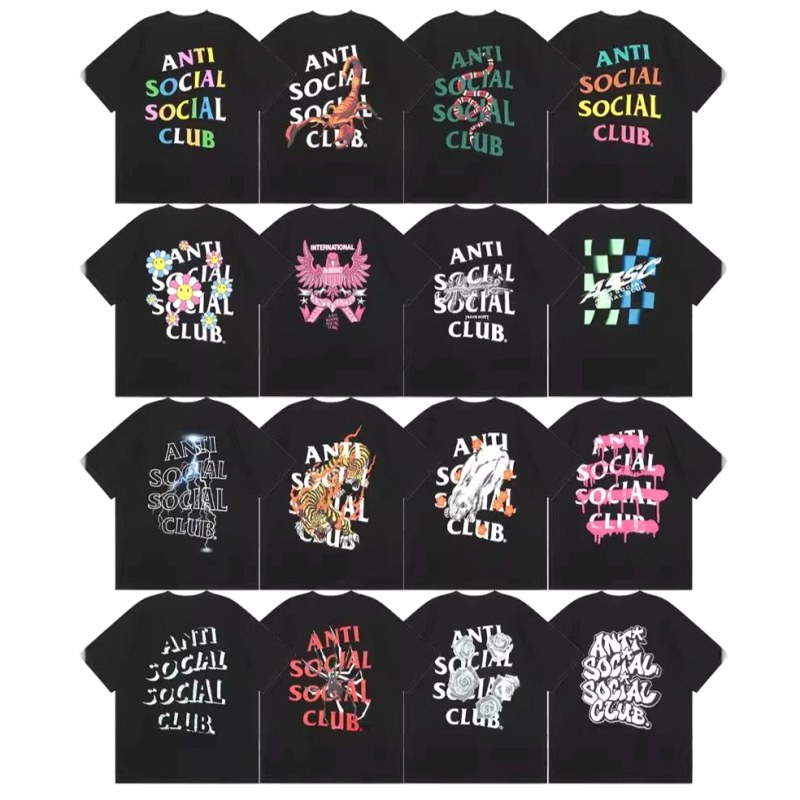
We ordered the Anti Social Social Club multicolor T-shirt collection the way we order most apparel, with one deliberate difference: the parcel was packed in the last week of September, inside the stretch our desk treats as the opening of the autumn surge. That calendar detail, not the chest graphic, ended up shaping this review. SKU 7718733486 is a single item ID wrapped around roughly 60 dropdown colour entries pulled from a cherry-blossom print series numbered 01 through 29, so we ignored the colour names, picked a print number on a black base in size M at $6.87, and spent the rest of the test on the things a service-terms desk can actually control — how the tee was folded, what protected the print, and what the packed parcel weighed against the figure the warehouse reported.
Everything below came out of the wrap on the steel table and was photographed in sequence: outer layer, inner protection, QC tag, then the garment.
Three packing set-ups, one print number
Rather than review a single parcel, we split the order across three and asked for different preparation on each, because a tee this cheap is almost never shipped alone by the time a seasonal haul is consolidated.
- Poly mailer, no stiffener. The tee was folded twice and bagged. Arrived flat but with a soft crease running across the back panel below the shoulder blades, which hung out after a night on a hanger.
- Poly mailer with a rigid card folder. The folder sat behind the chest print, so the fold line landed on the back rather than through the graphic. This was the only set-up where the printed chest panel arrived with no visible fold memory at all.
- Consolidated box. The tee went in with a pair of shoes and a hoodie, folded around a poly sleeve. No print damage, but it inherited two hard fold lines from the shoe boxes pressing on it for nine days.
The lesson was not that one packing method is right. It was that the fold line matters more than the outer material. A mailer with a card folder beat a box for this garment, and cost less to move.
Measurements before and after a cold wash
We flat-measured the size M on the table, cold-washed it inside out on a short cycle, air-dried it flat, and measured the same four points again. The listing quotes a loose fit and a 1–3 cm tolerance, so we were looking for movement smaller than the tolerance, not perfection.
| Dimension (size M) | Before wash | After cold wash and air dry | Change |
|---|---|---|---|
| Chest, pit to pit, flat | 54.0 cm | 53.1 cm | −0.9 cm |
| Body length, shoulder to hem | 70.5 cm | 69.8 cm | −0.7 cm |
| Hem width, flat | 53.0 cm | 52.4 cm | −0.6 cm |
| Raglan sleeve, collar edge to cuff | 33.5 cm | 33.0 cm | −0.5 cm |
| Garment weight, dry | 232 g | 233 g | +1 g |
Nothing moved beyond a centimetre, which is inside the tolerance the listing declares. The chest did not collapse, and the collar rib came back to shape after drying flat rather than hanging wet.
The 230 g knit on the desk scale
The listing calls for double-yarn cotton at 230 gsm; the warehouse weight field was left blank, so the only number we could test was the garment itself. Our size M read 232 g on the 0.1 g postal scale, which is consistent with a mid-weight knit of this cut but does not prove grammage — a whole-garment reading cannot separate fabric density from panel area. What we can say is that the tee is not a tissue-thin blank: it blocked light at the body panel, took a crease without going translucent at the fold, and felt comparable to a standard-weight retail blank rather than a promotional giveaway.
Raglan seams and the size-label caveat
The flat-lay promised raglan sleeves and the garment delivered them, with a clean four-panel join at the neck and no puckering along the diagonal seam on either side. That part of the listing is accurate.
The size label is a different matter. Buyers of this brand report the fit swinging both ways across drops — some size up at least one, others find the same label true to size or slightly generous — and the only reliable control is the chart for the colourway you select. Our M sat loose on a 178 cm frame with room through the body, which matches the listing's own description, but we would not reorder a second print number without re-reading the measurements. Treat the label as a starting point and the chart as the decision.
Print care inside a seasonal parcel
Owner reports on this brand's printed tees are consistent about heat: the graphics crack and peel when they go through a dryer, and hand-washing with a hang dry is the common advice. We cold-washed inside out and air-dried and saw no cracking, flaking or colour transfer onto a white base in the same load. We did not run a heated cycle, so the dryer warning stands untested by us and should be treated as a real risk rather than a preference.
The parcel-specific version of that advice is about folding, not washing. A chest print pressed into a fold for a week in a mailer is the damage a buyer never sees coming, and it is avoidable by requesting a card stiffener and a back-panel fold.
What the packing did to the billable weight
Packed figures from our log, weighed after sealing:
- Mailer alone: 0.31 kg packed.
- Mailer with card folder: 0.33 kg packed.
- Consolidated box: 0.36 kg attributable to the tee once packaging was shared across the shipment.
On a line that rounds up, all three of those landed in the same billable bracket, so the 20 g stiffener cost nothing in practice and bought the only undamaged chest print in the test. A tee shipped on its own, however, still pays a full bracket for 232 g of cotton, which is the argument for holding it for a consolidation rather than sending it solo.
Timeline, for planning purposes only
Our own parcel: order placed 22 September, warehouse check-in 25 September, QC photos the same day, packing request accepted 26 September, handover 29 September, delivery in Portland 12 October. That was a clean run inside the surge window. Timing on this brand has historically been the weak point, with handling quoted in the range of 14–24 business days before logistics were reorganised around 2023, so we would not read our dates as a promise for a November parcel.
What we would do differently next cycle
- Request the card stiffener on every single tee, not just the ones with a large chest print.
- Stop ordering one tee per parcel; the round-up eats the price advantage of a $6.87 item.
- Pick the print number first and the colour second — the series numbering is the only stable identifier in that dropdown.
How we tested
Opened on the steel table; photographed outer wrap, card folder, QC tag and tee. Flat-measured size M before and after a cold wash, weighed the garment at 232 g and each packed variant on the 0.1 g scale, and logged order, check-in, packing, handover and delivery dates.
Sources and notes
- Catalog product pageProduct listing verified on 2026-10-30.
Frequently asked
Does a single tee need a box, or is a poly mailer enough?
A mailer is enough if you add a rigid card folder behind the chest print and have the tee folded across the back panel. In our test that beat a consolidated box, which pressed two hard fold lines into the garment.
Why does the packed weight matter more than the tee's 232 g?
Shipping lines round up to the next bracket. At 0.31 to 0.36 kg packed, every set-up we tried billed the same, so the stiffener was effectively free — but a solo parcel still pays a full bracket for one tee.
Can the 230 gsm claim be verified from a kitchen scale?
No. A whole-garment reading of 232 g on a size M is consistent with a mid-weight knit, but grammage is grams per square metre and cannot be separated from panel area without cutting a swatch.
Editor verdict
A mid-weight loose raglan tee that measured close to its listing and survived a cold wash; the parcel needed a card folder, and the size label still demands a chart check.
What works
- Flat measurements held within the stated 1–3 cm after a cold wash.
- Chest print showed no cracking or colour transfer when air-dried.
- Garment weighed 232 g against a stated 230 g knit.
Watch-outs
- Owners report the print cracks in a dryer; we did not test heat.
- Size labels vary across drops, so a reorder is not blind-safe.
- A bare mailer left a fold crease across the back panel.
Community feedback 0
- Community feedback
- No approved comments yet.